Technical Education for AI Teams: Optimizing Storage Pathways and Hardware Integration
Artificial intelligence workloads have expanded at an exponential rate, shifting the primary bottleneck of modern data centers away from pure compute capability and squarely onto data transport pathways. Modern machine learning models, large language frameworks, and massive generative diffusion models require petabytes of training data fed continuously to hungry graphics processing units. Historically, traditional storage architectures routed data through the system memory and the host CPU before it finally reached the accelerator. This multi-step detour created severe performance traffic jams, leaving expensive parallel clusters sitting idle while waiting for disk input and output operations to finish.
Understanding how data moves through hardware subsystems is crucial for maximizing infrastructure efficiency. When designing an enterprise cluster or evaluating underlying bottlenecks, developers must look past raw core counts and examine how high-bandwidth memory interacts with storage arrays. For a deeper technical perspective on how foundational hardware components dictate real-world capability, review the foundational principles outlined in this GPU Architecture Breakdown: How VRAM, Bus Width, and Compute Cores Impact Real-World Performance. Overcoming these legacy storage hurdles requires specialized frameworks engineered to bridge the gap between high-speed silicon and dense storage pools.
Breaking Down GPUDirect Storage and the Role of cuFile
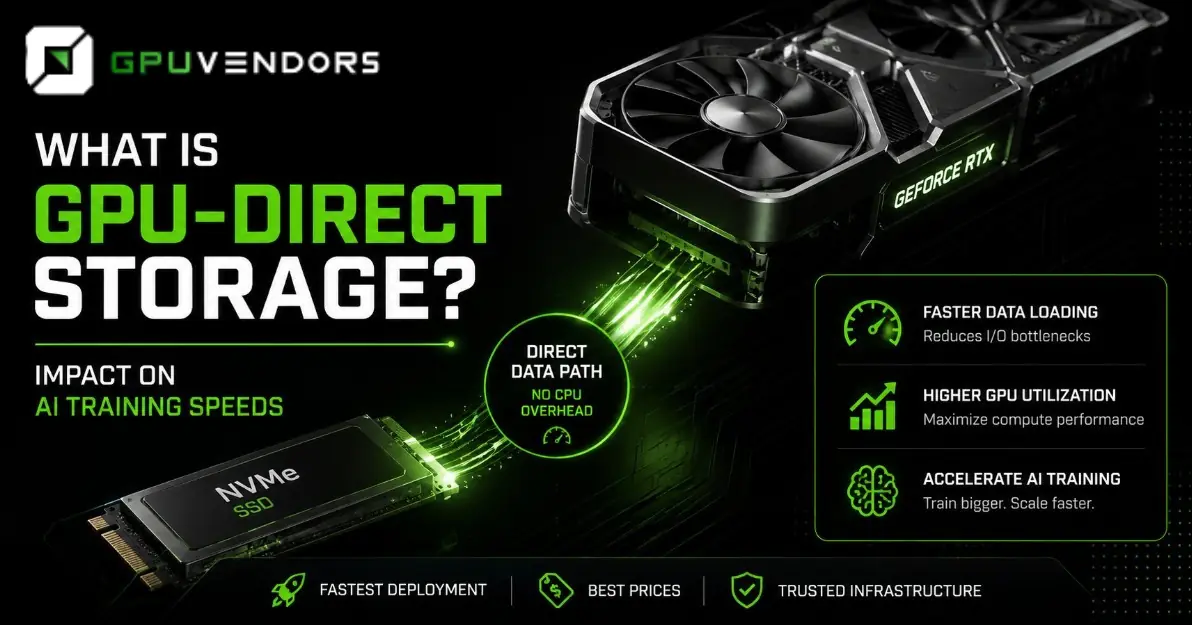
To solve the input/output starvation problem, advanced systems utilize GPUDirect Storage, commonly known as GDS. This direct communication technology establishes a high-speed, direct memory access path between local or networked storage subsystems and the memory space of the graphics card. By eliminating the traditional bounce buffer through system RAM, GDS drastically reduces input and output latency and minimizes host CPU overhead during intensive model training cycles.
At the core of this software stack sits cuFile, an advanced application programming interface library designed to streamline data transfers. Recent industry milestones, including open-source initiatives driven by major hardware vendors like NVIDIA at the Future of Memory and Storage conference, have made cuFile APIs openly available under collaborative industry groups. By opening the vertical storage software stack, developers and enterprise teams can utilize cuFile to read from and write to storage directly at microsecond speeds. This open approach ensures that multi-vendor storage ecosystems can interoperate seamlessly with parallel accelerators, reducing administrative overhead and supercharging data ingestion pipelines.
Why High-Speed Storage Integration Matters for Machine Learning
Training deep neural networks involves processing billions of distinct parameters across thousands of iterative epochs. If the storage subsystem cannot deliver training batches fast enough to match the processing velocity of dense tensor cores, compute units stall, wasting valuable time and energy. Implementing direct pathways transforms the efficiency of machine learning pipelines in several distinct ways:
Eliminating CPU Bottlenecks: Bypassing host memory routing frees central processing units to manage orchestration and network traffic rather than shuffling massive data blocks.
Maximized Accelerator Utilization: Keeping parallel clusters continuously fed with fresh data prevents expensive compute nodes from idling between training steps.
Accelerated Time to Insight: Reduced latency across storage tiers dramatically cuts down the total duration required to complete complex training cycles and model validation phases.
As data sets scale into the multi-terabyte and petabyte ranges, traditional storage frameworks simply cannot keep pace with the ingestion demands of modern enterprise workloads. Leveraging standardized frameworks like Scaled Accelerated Data Access allows massively parallel accelerators to pull only the necessary data straight from storage into high-speed memory pools, optimizing resource allocation across the entire cluster architecture.
Matching GPU Rentals with Modern Storage Infrastructure
Deploying high-performance machine learning models requires meticulous planning across multiple hardware layers. Organizations must balance compute density, network fabrics, and storage throughput simultaneously. When configuring multi-node environments or selecting scalable rental infrastructure, system architects often encounter challenges regarding physical spacing, power distribution, and thermal dissipation. Utilizing an interactive layout planning tool like the gpu rack configurator allows technical teams to map out chassis dimensions, power supply units, and interconnect cables before committing capital resources to a physical build.
Furthermore, acquiring enterprise-grade accelerators and matching them with robust storage nodes demands a streamlined procurement strategy. Navigating volatile spot prices and unverified vendor listings can delay critical project timelines. Securing authentic, warranty-backed hardware through a trusted best gpu marketplace ensures that your organization builds its AI infrastructure on a reliable, transparent foundation, maximizing both financial return and operational efficiency.