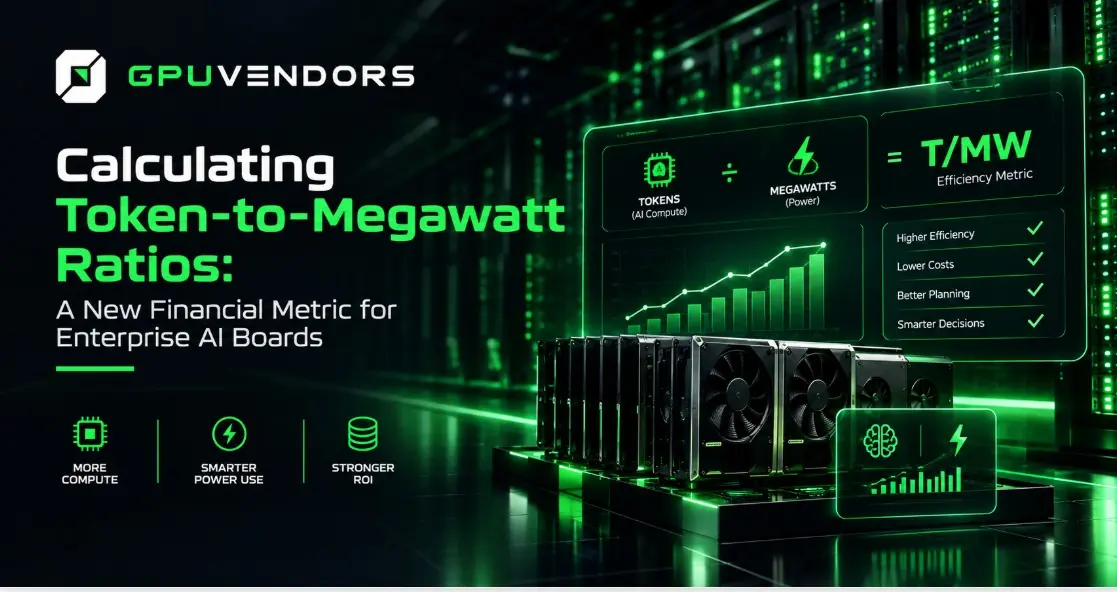
Enterprise boardrooms evaluating artificial intelligence infrastructure investments have long relied on familiar financial parameters. Capital expenditure per training job, return on investment per model iteration, and data center Power Usage Effectiveness dominated capital allocation conversations. These legacy metrics fail to capture the true operational and financial realities of modern large-scale cluster deployments. As model architectures scale into trillions of parameters, the primary constraint shifts from theoretical floating-point operations to sustained energy availability and effective output per watt.
Modern enterprise boards require a unified metric that connects facility power consumption directly to actionable business value. Token-to-megawatt ratios bridge this gap by measuring the total volume of successful inference tokens or model training progress delivered per megawatt-hour of electrical power consumed. Adopting this standard transforms how organizations evaluate data center site selection, hardware refreshes, and long-term operating budgets.
Deconstructing the Token-to-Megawatt Equation
Calculating token-to-megawatt efficiency requires examining both the compute hardware layer and the facility cooling overhead. When an enterprise cluster runs continuous multi-node inference or fine-tuning workloads, electrical draw fluctuates based on model quantization depth, batch sizes, and interconnect fabric saturation.
If facility cooling infrastructure requires excessive auxiliary power to maintain stable thermal limits, the net token output per megawatt drops significantly, even if the primary silicon performs at peak architectural capacity. Organizations evaluating power consumption profiles can utilize an Enterprise GPU power needs tool to model accurate facility baselines and dynamic workloads before committing multi-rack capital expenditure. Maximizing this ratio means eliminating hidden energy drains, such as thermal throttling from degraded cooling loops or unoptimized cluster topologies that stall pipeline parallelism.
Facility Limitations and the Power Delivery Bottleneck
Data center operators face a severe infrastructure crunch as high-density racks push power densities beyond fifty kilowatts per cabinet. Securing utility grid interconnections can take several years, leaving boards searching for ways to maximize output within existing power envelopes.
When facility power capacity is fixed, increasing overall cluster token generation relies entirely on upgrading hardware efficiency rather than expanding square footage. Deploying newer architecture generations improves token yield per megawatt, but transitional delays can stall production milestones. Mitigating these operational risks often requires balancing primary factory allocations with secondary market liquidity to secure deployment-ready nodes quickly. Ignoring the true cost of unbudgeted downtime can severely damage enterprise margins, a reality further explored in The Real Cost of Sourcing Readiness, which highlights why operational velocity frequently outweighs discounted legacy hardware.
Mitigating Operational Risk and Sourcing Readiness
Financial boards must also factor supply chain friction and hardware provenance into their token delivery equations. Unverified secondary market nodes or aging server batches often suffer from hidden thermal degradation, leading to premature clock throttling and diminished token throughput under sustained loads.
To protect capital investments, procurement teams rely on transparent grading frameworks and serial-verified inventory. Organizations looking to expand compute capacity without enduring lengthy primary manufacturing queues can source certified enterprise accelerators through the best gpu marketplace, ensuring batch homogeneity and predictable thermal profiles that align with board-level token-to-megawatt targets.
Strategic Takeaways for Enterprise AI Boards
Integrating token-to-megawatt metrics into corporate governance shifts infrastructure planning from a reactive cost center into an optimized profit engine.
Align Workloads with Power Efficiency: Prioritize model quantization and batch sizing strategies that maximize token throughput relative to real-time kilowatt draw.
Audit Thermal and Electrical Health: Monitor ongoing auxiliary power overhead to ensure cooling loops do not silently erode compute yield.
Secure Verified Inventory: Eliminate deployment friction by blending primary allocation plans with trusted secondary market sourcing channels to maintain uninterrupted token delivery schedules.