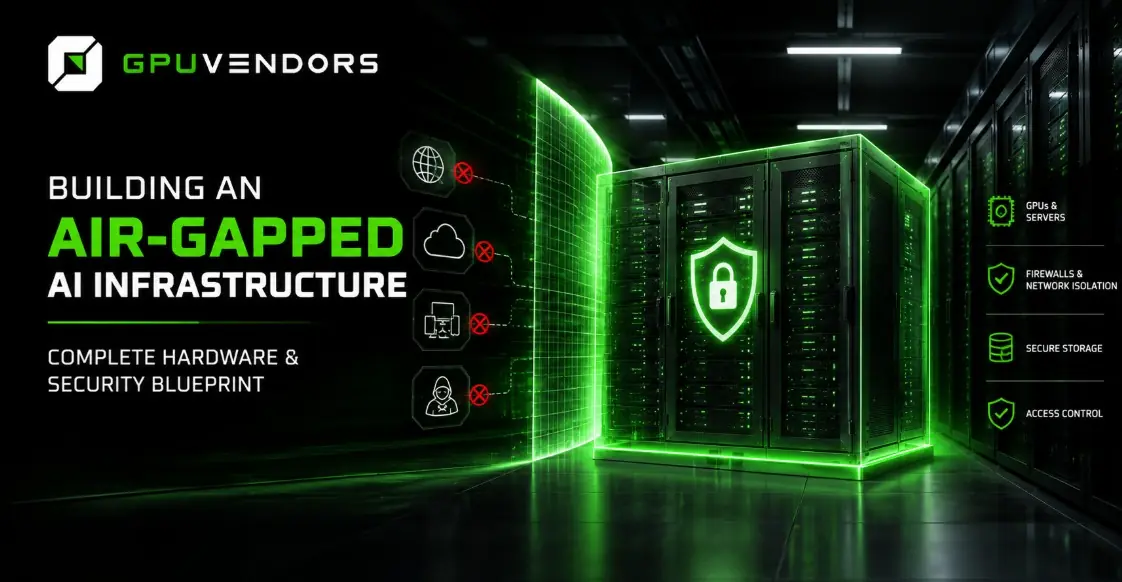
Air-gapped infrastructure means completely isolated systems with no network connection to the internet or external networks. It's the gold standard for protecting classified data, sensitive intellectual property, and regulated information.
Intelligence agencies, defense contractors, and financial institutions require air-gapped systems for mission-critical AI workloads. But air-gapping AI infrastructure is fundamentally different from air-gapping traditional servers.
GPU clusters demand massive data movement, complex cooling systems, and multi-node orchestration. Creating an air-gapped environment that's also performant and maintainable requires careful hardware selection and architectural planning.
This guide walks through the complete blueprint for building air-gapped AI infrastructure from hardware selection through operational security.
Understanding Air-Gapped Architecture
Air-gapped systems have zero network connectivity. No ethernet cables. No WiFi. No cellular connections. Data enters through physical media like USB drives or external hard drives. This eliminates network-based attack vectors entirely.
But air-gapping creates operational challenges. You can't automatically download security updates. You can't stream model weights from cloud storage. You can't monitor systems remotely. Every operational procedure becomes more complex.
For AI infrastructure, air-gapping means GPU clusters, storage systems, and compute servers all operate in complete isolation. This requires careful planning during procurement and deployment.
Hardware Selection for Air-Gapped Clusters
Choosing GPUs for air-gapped infrastructure is different from standard procurement.
You need GPUs with stable driver support for extended periods. New GPU architectures launch with frequent driver updates. If you can't access the internet for updates, you need proven, mature hardware where driver stability is established.
H100 and H200 GPUs are better choices than brand-new RTX 5090 systems. The extra cost is justified by stability and long-term supportability in isolated environments.
Memory capacity matters more in air-gapped systems. You can't stream model weights or training data from external sources. Everything must fit locally. This means 80GB H100 GPUs over 40GB variants, despite the higher cost.
Enterprise-grade hardware reduces failure rates. When you can't order replacement parts quickly, mean time between failures becomes critical. Enterprise GPUs have better reliability margins than consumer variants.
Procurement and Supply Chain Security
Air-gapped infrastructure requires extreme care during procurement. Your supply chain becomes a potential attack vector.
Buy from established vendors with verified integrity. Counterfeited or tampered GPUs could compromise your entire cluster. A best gpu marketplace that performs hardware verification and provides serial number tracking gives you confidence in component authenticity.
Verify hardware fingerprints before installation. Record serial numbers, firmware versions, and physical inspection notes. Any discrepancy between expected and received hardware gets flagged immediately.
Require supplier documentation of manufacturing conditions and quality assurance. For defense or intelligence applications, demand certificates of authenticity and supply chain verification.
Network Architecture and Isolation
Proper network isolation is the foundation of air-gapped security.
Build completely separate network infrastructure inside your secure facility. This means dedicated switches, routers, and cabling that never connect to external networks. Use switches without remote management capabilities. Disable all network ports that don't connect to cluster nodes.
Create physical barriers between air-gapped and standard networks. No shared infrastructure. No converged switching. No cross-connections that could accidentally bridge networks.
Implement strict USB and removable media policies. USB ports on cluster nodes should be disabled in firmware. Data transfer happens only through monitored, physically isolated systems in the secure facility's perimeter.
Cooling and Infrastructure Requirements
Air-gapped facilities often can't use standard cooling approaches because they require external monitoring systems and remote management.
Plan for locally-controlled cooling without network dependencies. Cooling systems need physical sensors and local control loops, not remote management. This means dedicated HVAC infrastructure specific to your cluster.
Understand cooling requirements before hardware selection. GPU clusters generate enormous heat. A 400-unit H100 cluster dissipates 280 kilowatts continuously. Proper cooling design is non-negotiable.
For high-density clusters, liquid cooling is almost mandatory in isolated environments. Liquid cooling provides better thermal efficiency than air cooling in dense rack configurations. See our guide on liquid cooling vs air cooling for high-density clusters to understand infrastructure trade-offs.
Storage and Data Security
Air-gapped systems require isolated storage architecture.
Use storage systems without network connectivity. Direct-attached storage via SAS or NVMe eliminates network data exposure. Storage arrays must operate with local management only, no remote access protocols.
Implement full-disk encryption on all storage. Even if physical drives are stolen, encryption prevents data extraction. Use hardware security modules (HSM) to manage encryption keys locally.
Plan for massive storage capacity. Air-gapped training requires local access to entire datasets. A 70B parameter model might need 100TB of training data. Storage planning happens before procurement.
Software and Environment Management
Managing software in air-gapped environments requires different approaches.
Create software repositories inside the secure facility. Instead of downloading packages from the internet, maintain local mirrors of required software: CUDA, cuDNN, PyTorch, TensorFlow, system libraries. Update these repositories only through controlled, monitored physical media imports.
Document all software versions and configurations comprehensively. Without the ability to reinstall from external sources, your documentation becomes your disaster recovery plan.
Test all software thoroughly before deployment. No iteration or debugging happens in production because you can't quickly pull new versions. Everything must work before activation.
Configuration and Capacity Planning
Before building air-gapped infrastructure, define requirements precisely.
Use an infrastructure configurator to model exact cluster specifications. Determine GPU count, memory requirements, storage capacity, and networking topology. Test configurations before procurement.
Specification changes after procurement are expensive and slow. You're ordering components for delivery into a secure facility with strict access controls. Oversizing early costs less than adding capacity later.
Plan for redundancy and spares. In standard environments, you order replacement parts quickly. In air-gapped facilities, spares sit on-site waiting for failures. Budget for 10-15 percent spare inventory.
Operational Protocols and Maintenance
Air-gapped operations require documented procedures for everything.
Create comprehensive operational runbooks for common tasks. Rebooting a node, replacing a failed GPU, updating software all need detailed procedures. These procedures never assume external connectivity.
Schedule maintenance windows carefully. System updates require downtime. Unlike cloud environments where you spin up replacement capacity, air-gapped clusters stop production completely during maintenance.
Implement strict physical access controls. Every person entering the secure facility gets logged. All activities get documented. Chain of custody for all maintenance work is maintained.
Security Monitoring Without Compromise
Monitoring air-gapped systems means local infrastructure with no external reporting.
Install hardware-based monitoring systems inside the facility. Temperature sensors, power supplies, network analyzers all report locally to on-premises dashboards. Never to external systems.
Implement intrusion detection systems that operate locally. These systems monitor for suspicious network activity without sending alerts outside the facility.
Create air-gapped backup systems for disaster recovery. Backups store locally with no remote replication. Regular testing ensures backups restore correctly.
Getting Started with Air-Gapped Infrastructure
Building air-gapped AI infrastructure is complex. But it's essential for organizations handling classified or highly sensitive data.
Start by defining security requirements precisely. How isolated does the system need to be? What data flows in and out? What operational procedures are acceptable?
Then work backward from requirements to hardware and architecture decisions. Every hardware choice, every software decision, every operational procedure flows from security requirements.
Finally, plan for the long term. Air-gapped systems run for years between major upgrades. Oversize capacity, choose stable hardware, and maintain comprehensive documentation. Your future operations team will thank you.riting…