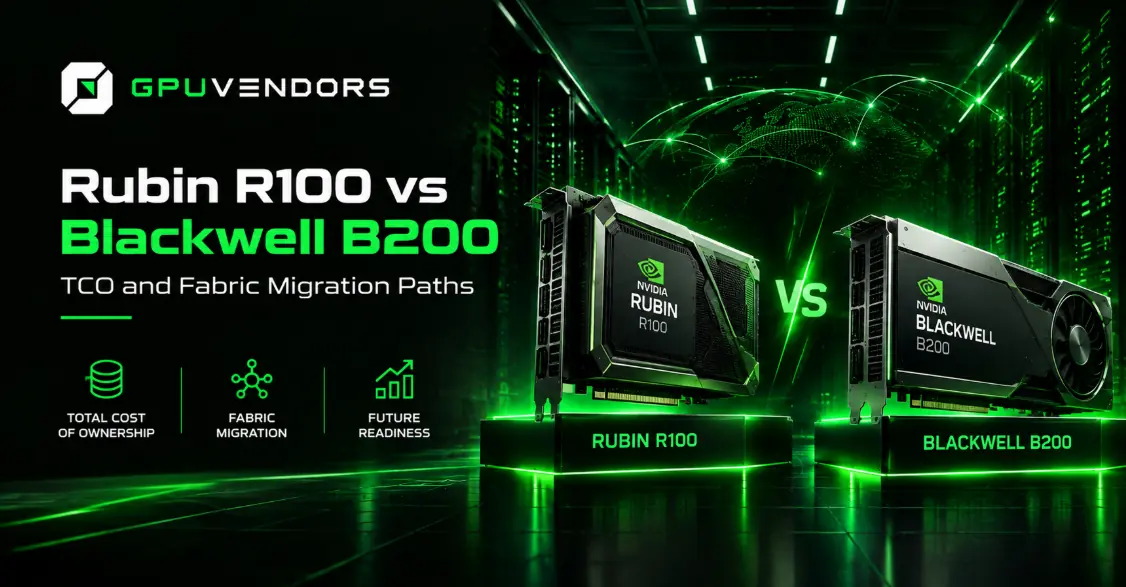
The introduction of the Vera Rubin R100 generation will mark a game-changing evolution in enterprise AI infrastructure, from NVIDIA Blackwell B200 generation to Vera Rubin R100 generation. The B200's high-bandwidth memory, HBM3e, is used in dual-reticle multi-chip modules for enterprise-level training superiority at baseline, and dense FP4/FP8 capabilities. The R100 silicon will feature 288GB of HBM4 memory for each GPU and transistors of 336 billion, produced by the advanced 3nm manufacturing process.
With respect to inference and fine-tuning, this capacity boom has revolutionized workload builders' lives. Sharding and quantization of a B200 node rapidly becomes difficult for very large frontier models, and an R100 allocation adds a vast amount of local memory and local bandwidth. This will be a choice which will be made in conjunction with intermediate hardware options, such as the Blackwell Ultra's HGX B300 vs HGX B200: How Much More Does Blackwell Ultra Deliver?, in order to meet the performance demands of each generation before full scale deployment of R100 racks is available.
NVLink and Scale-Up Bandwidth Realities
The road ahead for NVLink and scale-up bandwidth realities is not about peak matrix math, but rather about the inter-GPU communication latency and all-to-all scale-up fabric bandwidth that limits the efficiency of a cluster. Blackwell B200 systems support 5th generation NVLink architectures that are optimized for 8-GPU nodes with high density and for larger NVSwitch domains. One of the key challenges with distributed training is when the gradient synchronization and pipeline parallelism exceeds the capacity of switch cross-sections in multi-rack SuperPOD configurations.
Scaling up bandwidth for all-to-all communication in the NVSwitch fabric, Rubin R100 gives you a bandwidth of 3,600 GB/s, on top of NVLink-C2C coherent CPU/GPU links at 1,800 GB/s, and support for PCIe Gen 6. The cluster operators can gain an extra half synchronization stall reduction when using B200 fabrics to R100 fabrics in the context of having agents executed in a multi-agent loop and heavy mixture of experts token routing. The use of these fabric transitions should be considered when making infrastructure planning decisions, before any physical delivery slots for racks are available in regional data centers.
Total Cost of Ownership for Multi-Node Fleets
What is Total Cost of Ownership for Multi-Node Fleets and how to compute it? Enterprise AI factories TCO can be segmented to tokens per megawatt, cooling loops, power delivery infrastructure cost to the enterprise and amortized hardware acquisition cost. B200 deployments provide predictable levels of operational TCO by mid-2026 and have well-established amortization schedules as well as ecosystem compatibility.
Denominator of the TCO equation is changed due to R100 introduction. R100 is able to achieve a much greater agentic throughput per unit of energy, as compared to the same frontier workload convergence, resulting in a much lower physical footprint required. Friction around upfront capital expenditures does, however, include a premium for coolers that are early adopters, higher thermal flux densities, and potential next generation cooler facility retrofits. R100 has a higher unit efficiency than the proven Blackwell inventory which could be priced instantly and is available in the marketplace.
Interim Infrastructure Strategies and Ultra-Class Comparisons
Most enterprise firms do not have an ideal relationship between capital refresh plans and semiconductor releases. Waiting without interruptions to R100 volume availability leaves a deployment gap: there is more demand for the cluster to serve when it's in use than there is volume available. To fill-in production gaps, transitional inventory or mixed generation pools are used.
Operators accessing the best gpu marketplace can source verified pre-owned or surplus enterprise accelerators to achieve interim training targets, or to add to intermediate cluster capacity without waiting years for factory orders to be fulfilled. This transactional liquidity will, along with the proper topological design, help to ensure the correct integration of interim B-series nodes before deployment of R100 or Rubin Ultra scale-up racks.
Migration Playbook for Enterprise Infrastructure Teams
The process of a clean migration from B200-base to R100 fabric architecture is not simply one of ordering guesses, but deliberate engineering stages.
Workload Mapping & Assessment of Learning
Characterize the model parallelism frameworks being used and identify communication bound kernels that can be readily accelerated by using NVLink 6 bandwidth.
Isolate inference intensive microservices from long horizon multi-node training clusters to isolate upgrade priorities.
When choosing secondary footprint for transitional nodes, make sure to have space allocated for inter-rack power and thermal buffers for your Configure your GPU cluster.
Recommendations on Procurement and Risk Management
Maintain operational liquidity with primary allocation reserve and secondary market sourcing to grow capacity on the fly.
Track rack-scale cooling distribution, NIC interconnect speed upgrades (800Gbps infrastructure up to forward) and track firmware maturity.
Roll out R100 islands in phase with existing management planes, and connect to the existing management plane in a neat and standard SuperNIC fabric.
It's key to enterprise AI infrastructure success is how quickly you're able to move architectural adoption in line with demonstrated power of facilities and secondary market liquidity. Infrastructure is followed by fabric migration as an ongoing optimization cycle, leading to long-term ROI.