If your latest server quote came back far higher than you expected, you're not misreading it. The Global HBM Squeeze has become the defining procurement story of 2026, and it's forcing IT teams to tear up budget assumptions they made just a few months ago.
The root cause is High-Bandwidth Memory (HBM) - the specialized memory that fuels AI accelerators such as NVIDIA's Blackwell platform. As AI data centers expand at a pace few manufacturers anticipated, they're pulling in HBM and related wafer capacity faster than the industry can replenish it. That demand isn't staying contained to AI clusters - it's now bleeding into the memory budgets of ordinary enterprise servers.
What's Behind the Global HBM Squeeze
AI accelerators require far more memory bandwidth than conventional CPUs or standard enterprise servers. To keep up, major DRAM producers - Samsung, SK hynix, and Micron among them - have been shifting wafer capacity away from conventional DRAM production and toward HBM and other AI-focused memory products.
This isn't a small reshuffle. Industry estimates point to a substantial share of total DRAM wafer output being redirected toward HBM to satisfy accelerator demand. Every wafer allocated to HBM production is one less wafer producing the standard DIMMs that keep everyday enterprise servers running.
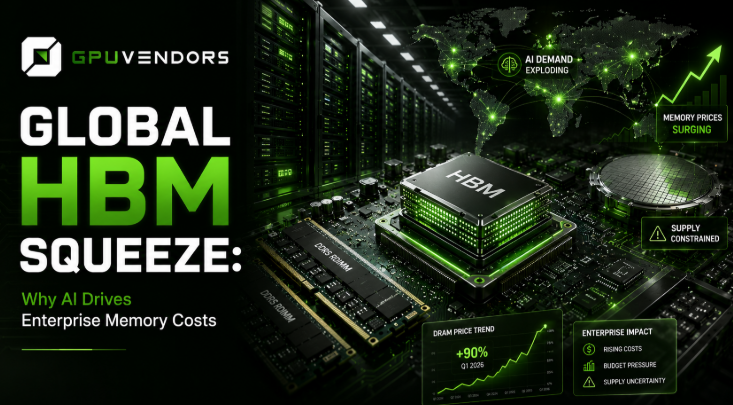
Market researcher TrendForce has revised its pricing outlook upward more than once as the situation has unfolded. TrendForce now expects conventional DRAM contract prices to climb 90% to 95% quarter over quarter in the first quarter of 2026 - a steep jump from its earlier forecast of 55% to 60%. Enterprise SSD pricing is expected to follow a similar trajectory, as NAND Flash capacity comes under comparable strain. Samsung has acknowledged that the shortage is no longer isolated to a single supplier; pricing pressure is now hitting the industry as a whole.
The takeaway: the Global HBM Squeeze isn't a short-lived spike tied to one product category. It reflects a structural change in how memory capacity gets allocated - one that's affecting nearly every enterprise buyer, whether or not AI workloads are part of their infrastructure.
Also read: NVIDIA H200 vs H100: The Memory Upgrade That Doubles LLM Inference
How the Global HBM Squeeze Is Reshaping Server Budgets
For procurement and IT teams, the fallout tends to show up in three distinct ways:
1. Unpredictable bills of materials. When core memory components swing by double- or triple-digit percentages within a single quarter, forecasting a server's bill of materials (BOM) becomes far less reliable. A configuration approved and budgeted last quarter can easily fall outside this quarter's financial parameters.
2. Tougher trade-offs. Facing sharp memory cost increases, procurement teams are frequently left choosing between fewer DIMMs per node, redesigning around denser (and pricier) memory modules, or pushing planned refresh cycles further out until the market settles.
3. Unequal exposure. Not every buyer absorbs the impact the same way. Hyperscale cloud providers often lock in supply through long-term agreements directly with memory manufacturers. Mid-market enterprises and typical IT departments rarely have that same negotiating power, leaving them more vulnerable to sudden price jumps and longer lead times.
In other words, the Global HBM Squeeze isn't just an industry headline - it's quickly becoming a real line item on next quarter's capital expenditure plan.
What Procurement Teams Should Do Now
Given how quickly pricing continues to move, waiting for conditions to stabilize is a risky bet. A more grounded approach looks like this:
- Refresh your budget assumptions right away. Last quarter's memory pricing is already outdated - rebuild your cost model around today's market, not historical averages.
- Re-check approved configurations against current pricing. A build that penciled out when it was approved may no longer be the most cost-efficient path forward.
- Pressure-test refresh timelines. Run planned hardware refreshes against higher memory and SSD cost scenarios before locking in budget, not after.
- Revisit AI workload assumptions. Not every AI-adjacent deployment truly needs the memory headroom that last year's designs called for. Right-sizing memory allocation can help offset some of the pressure created by the Global HBM Squeeze.
None of these steps make the pricing pressure disappear, but together they significantly reduce the odds of a mid-project budget surprise.
See What This Means for Your Own Cluster Budget
Understanding the Global HBM Squeeze in theory is one thing - seeing exactly how it plays out on your own cluster budget is another. Component-level price shifts of this size don't just affect your bill of materials; they also shift the power and cooling math for every node, particularly across multi-node deployments.
Use our power calculator to calculate server power consumption and adjust your cluster budget for 2026 memory prices
Running your current configuration through updated pricing and power estimates only takes a few minutes - and it can surface budget gaps well before they show up in a vendor quote.
The Bottom Line
The Global HBM Squeeze is a direct byproduct of AI infrastructure scaling faster than memory manufacturers can comfortably keep pace with. Wafer capacity is shifting toward HBM and other AI-linked products, conventional DRAM contract prices are climbing at record rates, and enterprise buyers without long-term supply agreements are bearing the brunt of it.
The organizations that come out ahead won't be the ones hoping prices drift back toward 2025 levels. They'll be the ones actively rebuilding their budget models, reassessing configuration choices, and stress-testing refresh timelines against today's market realities - not last quarter's.
If a hardware refresh or new cluster deployment is on your roadmap in the coming months, now is the time to run the numbers before the next round of pricing revisions lands.