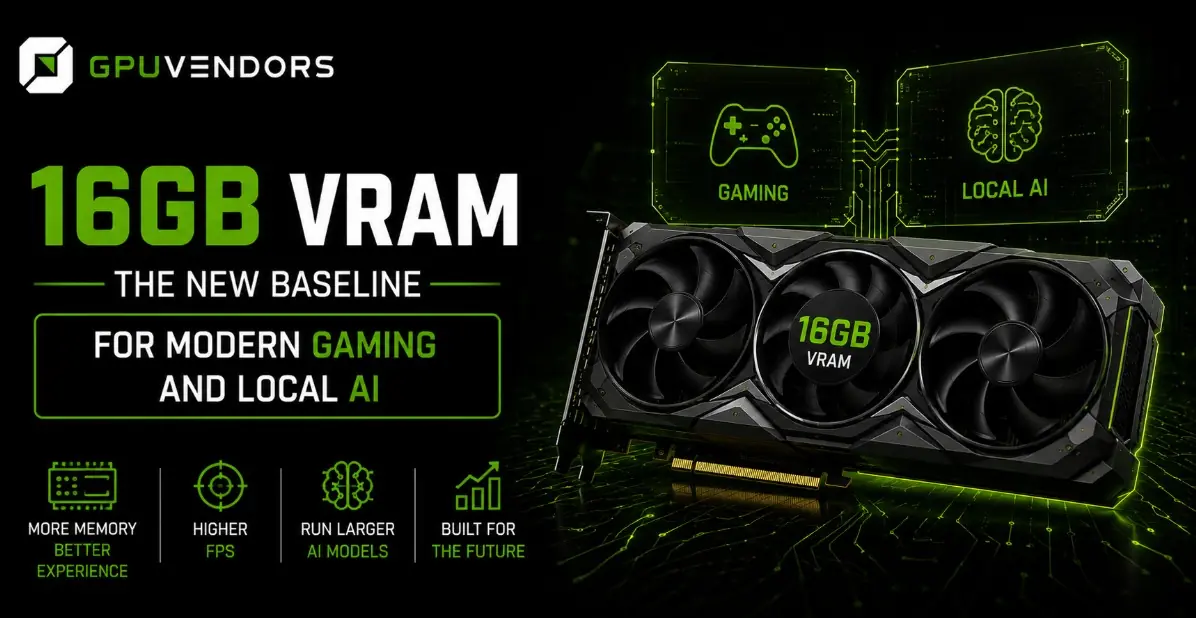
The graphics card industry has evolved faster over the last few years than at any other point in hardware history. For a long time, video memory allocation felt like a secondary metric—something left to professional renderers and extreme multi-monitor setups while gamers focused strictly on core clocks and rasterization throughput. Today, that narrative has completely inverted. As software developers push the boundaries of real-time rendering, high-resolution texture streaming, and local artificial intelligence execution, video memory has emerged as the ultimate gatekeeper of system performance.
If you are planning a system upgrade, building a dedicated workstation, or re-evaluating your current hardware stack, one truth stands clear: 16GB of VRAM is no longer an enthusiast luxury tier. It has officially become the required baseline for a seamless, future-proof experience in both modern gaming and local AI workflows.
The Gaming Shift: Why 8GB and 12GB Are Hitting Walls
To understand why 16GB VRAM is necessary, we must examine how modern game engines handle data. Gone are the days when textures were small, compressed assets loaded entirely into system RAM and trickled over to the GPU on demand. Modern titles utilize massive asset streams, virtualized geometry, uncompressed high-resolution textures, and complex ray-tracing or path-tracing pipelines that demand massive local frame buffers.
At 1080p resolution, legacy cards with smaller memory buffers might still scrape by. However, once you scale up to modern 1440p or native 4K gaming, the memory consumption spikes dramatically. When a game demands more video memory than your physical hardware possesses, the GPU is forced to offload data into standard system RAM over the PCIe bus. This results in severe frame pacing stutters, sudden texture popping, and stuttering frame drops that ruin fluid gameplay regardless of how fast your core clock speeds are.
Furthermore, modern upscaling technologies and frame generation features—while brilliant for boosting frame rates—require additional frame buffer overhead to store temporal data vectors. Cards equipped with 12GB or less are increasingly encountering allocation warnings in modern AAA titles at maximum settings. A 16GB buffer provides the breathing room needed to run high-resolution texture packs, advanced lighting models, and high refresh rates without triggering hardware bottlenecks.
The Local AI Boom: Why VRAM Dictates Model Capability
While gaming pushes memory limits through high-fidelity graphics, the local AI revolution has completely transformed how consumers look at computing power. Running large language models (LLMs), stable diffusion pipelines, and coding assistants locally has shifted from a niche hobby into a mainstream productivity standard.
Unlike gaming, where performance drops when VRAM is exceeded, running local AI with insufficient memory leads to an entirely different outcome: absolute failure or unusable performance. When you load a model into memory, its parameters must reside directly within the GPU's fast working memory. If the model exceeds your VRAM capacity, it either refuses to load entirely or relies on CPU offloading, which reduces generation speeds to a crawl.
In the current landscape, popular open-weight models and advanced architectures demand significant memory footprints. A standard 16GB frame buffer serves as the sweet spot for running mid-sized quantized language models, handling complex image generation pipelines at higher resolutions, and maintaining reasonable context windows without constantly tweaking configuration settings. Sourcing hardware with adequate memory ensures that your machine functions as a reliable development environment rather than an endless exercise in memory management.
Evaluating Memory Bandwidth and Architectural Longevity
Capacity is only half of the equation; the speed at which data moves across the memory bus dictates overall efficiency. Modern 16GB cards typically pair their generous frame buffers with wide memory buses and high-speed memory architecture. This ensures that high-bandwidth data transfers—whether loading complex 3D meshes or processing multi-layered AI training datasets—happen instantly.
When planning a long-term hardware investment, avoiding obsolescence requires looking closely at total system specifications. Buying a sub-16GB card today means saving a marginal amount of money upfront while inviting a premature upgrade cycle as software demands continue to climb. A robust 16GB card bridges the gap between mid-range affordability and high-end endurance, protecting your investment for years to come.
Smart Hardware Sourcing and Component Evaluation
Navigating the current hardware market requires careful research into specifications, pricing trends, and verified vendor reliability. Whether you are hunting for a brand-new graphics card or assessing pre-owned enterprise hardware, having access to structured data makes all the difference.
Before committing your capital, performing a thorough
To explore verified listings, transparent market rates, and detailed hardware specifications from trusted suppliers, check out the
Final Thoughts: Securing Your Next-Gen Compute Stack
The computing ecosystem has reached a definitive turning point. As modern game engines demand deeper texture buffers and local AI integration becomes a standard daily tool, sub-16GB hardware is rapidly approaching its expiration date. Choosing a 16GB graphics card provides the structural headroom required to game at high resolutions, run powerful local models, and multitask without compromise.
By investing in a well-balanced system with a generous memory buffer, you eliminate performance bottlenecks and future-proof your setup. Explore current market inventories, compare live pricing, and equip your rig with confidence by utilizing the