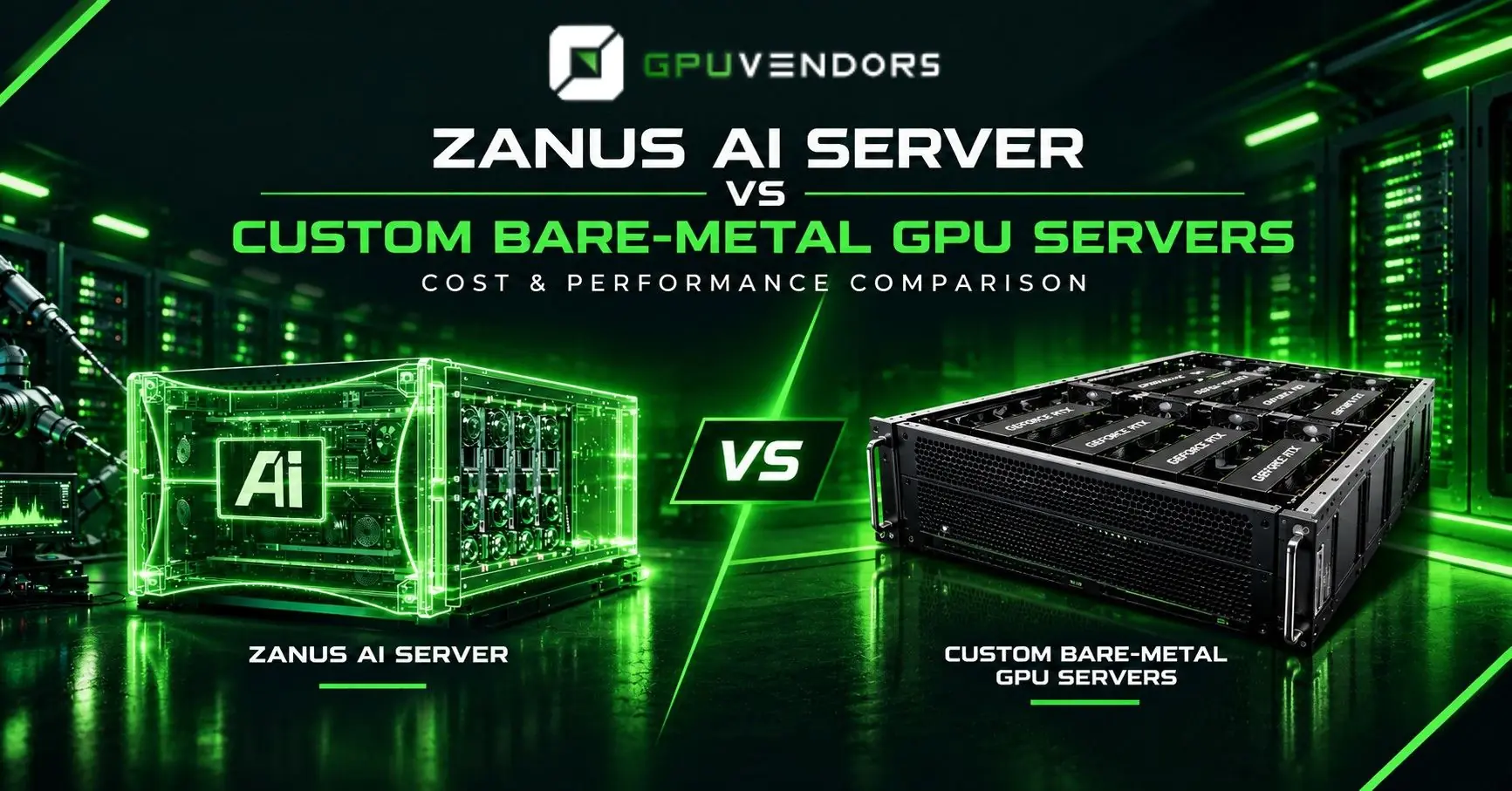
Two Different Products for Two Different Problems
Zanus AI and a custom bare-metal GPU server are often mentioned together, but they serve different purposes. Zanus describes itself as a private AI server for companies that do not need coding knowledge. It is a hardware appliance housed inside the customer's building, complemented by hosted subscription plans for front-office and back-office automation.
A bare-metal GPU server is a standalone machine set up to your own needs. You install the operating system, frameworks, and models yourself. That difference shapes every comparison that follows. Before you weigh cost or performance, decide whether you need a pre-packaged business tool or a raw compute platform that your engineers can build on.
What Zanus Offers
The vendor's published material describes Zanus as three layers. The front-office layer handles calls, web chat, quotes, and bookings. The back-office layer is an operating system with more than fifteen modules. A private, on-premises option is marketed as air-gap capable.
The hosted front-office plans cost between $329 and $2,495 per month and are managed by the vendor. Prices for the on-premises appliance are available only on request, and no public hardware price is listed. The published material also does not name the GPU model, the amount of video memory, or the amount of system memory in the appliance. It says only that models are sized on GPU memory and RAM. These gaps make a direct performance comparison difficult.
Cost Comparison in Practice
Bare-metal costs are easier to estimate because the components are published. A dedicated GPU server carries the cost of hardware, power, cooling, rack space, networking, and the staff time needed to manage it. At high utilisation, power is often a considerable line item, so the monthly bill depends heavily on how many hours the machine runs under load.
A Zanus appliance turns much of that cost into a fixed or subscription price. The vendor states that the appliance draws up to 6 kW at full load and that running it at full load costs roughly $1 per hour. These are vendor claims, so compare them with your own electricity tariff and facility. Whether the subscription makes sense depends on whether you need the packaged business workflows at all. Paying for an appliance that duplicates tools you already have is wasteful, however good its price.
When you compare quotes, include every cost. For a bare-metal build, that means hardware, hosting or colocation, power, support contracts, and engineering time. For Zanus, include the subscription or purchase price, installation, integration work, and any service fees.
Why Performance Is Hard to Compare
Performance claims are hard to test across these options. Zanus does not publish benchmarks for its hardware. Its target workloads, such as customer calls and booking workflows, differ from the training and inference jobs typical of bare-metal GPU servers. A fair comparison needs the same model, the same prompts, the same concurrency, and the same latency targets on both systems.
Bare-metal performance depends on the GPU, its memory size, and the model you plan to run. Smaller models fit on cards with modest video memory, while larger models need more memory or multiple GPUs. Test throughput and latency on your own workload before you commit to a configuration.
Ownership, Privacy, and Control
The biggest practical difference is control. A bare-metal server gives your team complete access to the operating system, the model weights, the network, and the data. You choose the software stack and can change it as your needs evolve. The cost is responsibility: your team must patch, monitor, secure, and back up the machine.
For regulated industries, an on-premises appliance keeps data inside your facility. The trade-off is less flexibility. You depend on the vendor for updates and for the integrations it has built, and extending the system may require additional tooling. Hosted plans store data in the vendor's environment, which may not meet every compliance requirement.
Sourcing and Lead Times
Hardware availability sets the timeline, whichever route you take. Viperatech, a UAE-based AI hardware supplier, states on its Best AI Hardwares Store in the UAE news page that enterprise GPU and server purchases require compliance forms before a quote is issued. The same page gives lead times of 8 to 14 weeks for some HGX B200 and B300 systems, and describes Blackwell-series card prices as "stabilised but supply-constrained." Prices and lead times change, so confirm them with the seller before planning a deployment.
If you are building your own GPU server, you can buy AI server configurations directly from listed sellers. When stock, price, and warranty terms appear together in one listing, the options are easier to compare.
Buying From a Trusted Marketplace
A best gpu marketplace lets you compare listings from several sellers side by side, including price, stock, warranty length, and return terms. These details matter more for server hardware than for consumer cards, because a failed server and a slow replacement carry a real cost to the business.
Ask every seller for written specifications, warranty coverage, and a delivery date. Store serial numbers, invoices, and support contacts in one place, so that any future claim is simple to make.
Choosing the Right Direction
Choose a packaged appliance if you want a working business workflow with minimal engineering effort, and the vendor's features match your needs. Choose a bare-metal GPU server if you need control over models and data, have engineers to run the system, and want to tune cost and performance yourself.
Either choice depends on your own workload, your compliance requirements, and a total cost that includes staff time. Vendor figures are a starting point, not a substitute for testing.
Final Takeaways
Zanus AI and bare-metal GPU servers answer different questions. Zanus packages AI into a business tool with subscription or appliance pricing, while a bare-metal server gives you raw capability and full responsibility. Cost comparisons depend on hardware, power, staffing, and the workflows you actually need. Performance comparisons require the same workload on both systems, which Zanus has not yet published. Test your own workload, confirm lead times and warranty terms, and buy from sellers whose terms you can verify.