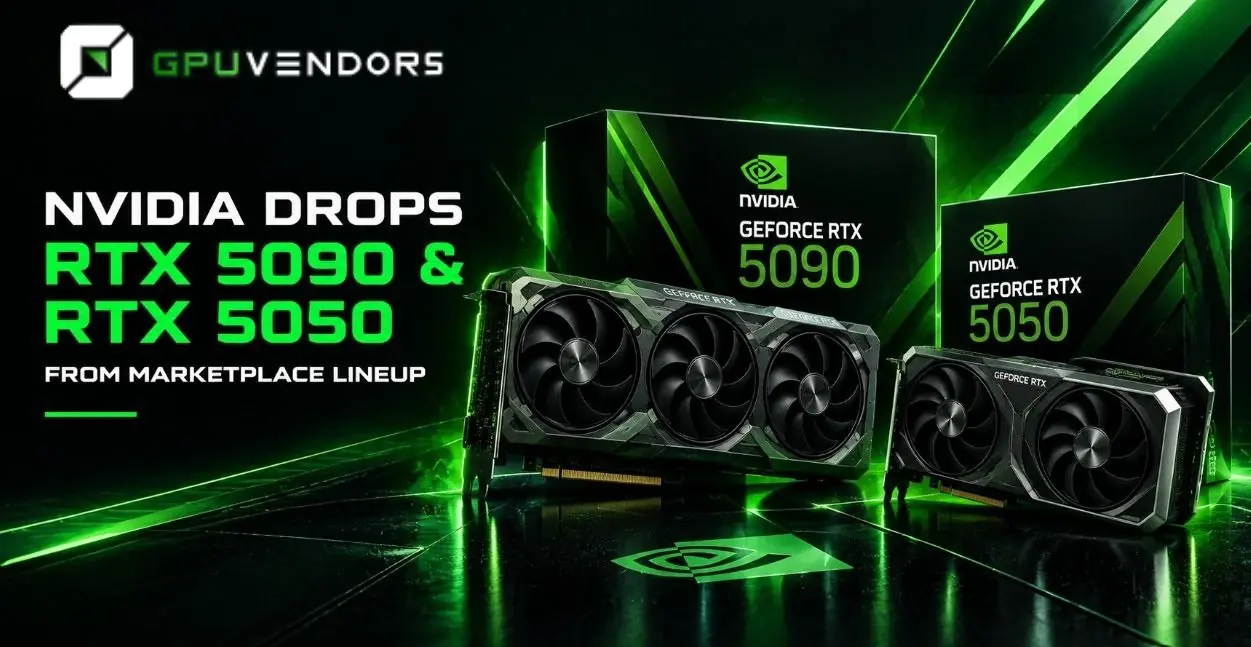
It's not often that a flagship card is dropped from a list alongside an entry-level card, and when this happens, shoppers are left wondering. Nvidia announced the planned withdrawal of the RTX 5090 and RTX 5050 from the marketplace, sparking confusion on the availability, pricing, and value of the two models. This article distinguishes between what is definitely known and what is not, and offers sensible suggestions for anyone who is thinking about buying either of these cards.
What Is Known and What Is Still to Be Confirmed
Don't take any lineup report for granted; always make sure to look where the report came from. Official announcements from a manufacturer are more reliable than word of mouth, and a retailer's list can be updated for reasons beyond the manufacturer's product approach. A card might be out of stock with one seller because the demand exceeded the supply, or it could be offered under another name or area. Use a headline to check facts rather than as a final conclusion.
It is also prudent to distinguish between two cases:
Discontinued: A product is no longer available from the manufacturer.
Temporarily Unavailable: No stock is currently in place, but the unit is still being produced.
The implications for buyers are quite different in those cases. A card that isn't available now can be limited in supply and not get available again, while a card that's already discontinued can come back later. Before you buy, ask sellers directly: which is the case?
Next-Generation Offerings: Flagship vs. Entry-Level
The RTX 5090 and RTX 5050 are both NVIDIA's next-generation offerings.
The RTX 5090 is targeted at gamers and content creators seeking the best performance and willing to spend the money, making it the clear flagship.
The RTX 5050 is designed with entry-level gamers in mind who want a reliable and budget-friendly graphics card.
The removal of cards from both ends of the range implies that any change might be due to supply planning, pricing, or channel strategy rather than one common factor. If it isn't explicitly explained, any single answer would only be speculation.
Buyers should ask themselves, "Does my requirement match either of these two?"
If you're in a position to handle intensive 4K gaming, creative endeavors, or AI tasks where memory and processing power are paramount, a flagship card is the better option. An entry-level card is designed for lighter games and moderate resolutions or for a standard workstation. Most consumers are in the middle, where a middle-of-the-road card could work best for them.
What to Do If the Target Card Is Not Available
If the card you wish to see is not on major listings, expand your search and don't settle. Look at close alternatives in the same performance class; compare specifications, power consumption, and game or application benchmarks. Also consider previous generation cards, as they can provide exceptional value when new generation cards are hard to find.
If you want to go deeper into the performance of the top card in comparison to its closest sibling, then read our breakdown of
Comparing Alternatives Carefully
When you
Memory and Bandwidth: Vital for high-resolution textures and AI computations.
Dimensions and Thermal Design: If there's a card that's a little slower, but fits your case, runs cooler, and is cheaper, it may be the better buy.
Real-World Benchmarks: In actual gaming and applications, compare results across different cards, as performance differences can vary significantly depending on the title or software.
Power Requirements: Flagship cards require a high wattage power supply and multiple connectors. These extra power infrastructure costs can alter the overall best value decision.
Shopping Strategy for Short Supply Conditions
Because stock may be limited, it's imperative that you make prompt decisions without making errors. Before you begin:
Determine your budget limit.
Set your minimum hardware configuration requirements.
Configure price alerts where available.
Avoid making an offer on a listing that appears too good to be true, particularly from an unknown seller.
A
Always check what's included in the box. Some options include needed power adapters or display cables, while others require separate purchases. Take those extra costs into account when calculating the overall price to determine which listing is truly the cheapest.
Protecting Your Purchase
Once your order is complete, protect your investment with these steps:
Keep Documentation: Store your order confirmation, serial number, and warranty papers together.
Register the Card: If possible, register the card directly with the manufacturer to ease the process for future warranty claims.
Test Immediately: Test the card as soon as you receive it. If it is faulty, notify the seller within the designated return period.
System Checks: Use the newest graphics drivers and check operational temperatures and stability during your initial sessions. If you notice crashes, visual artifacts, or odd thermal behavior, contact the seller and manufacturer immediately.
What to Watch Next
Currently, watch official manufacturer messages and trusted tech news for clarification. The lineup will become clearer in the coming weeks as retailers adjust their offerings and manufacturers update their official product pages. It is best to wait until you have confirmed information so that you do not end up purchasing hastily during a short-term shortage or buying a card that will not fit your long-term needs.
Review your needs again as well. If the lineup changes, it could mean that you should rethink the need for the top model entirely, or consider whether a mid-range card can perform the job at a much more reasonable price point.
Final Takeaways for Shoppers
Reports about removed models should prompt careful checking rather than panic buying:
Confirm what has actually changed before taking action.
Distinguish discontinued products from temporary stock shortages.
Define your exact performance requirements before comparing alternatives.
Use a trusted marketplace to evaluate pricing, warranty terms, and real-time inventory across multiple sellers.
Read independent benchmarks for the specific games and applications you rely on.
With this approach, you can make a sound, value-driven purchase whether or not your first choice remains in the official lineup.