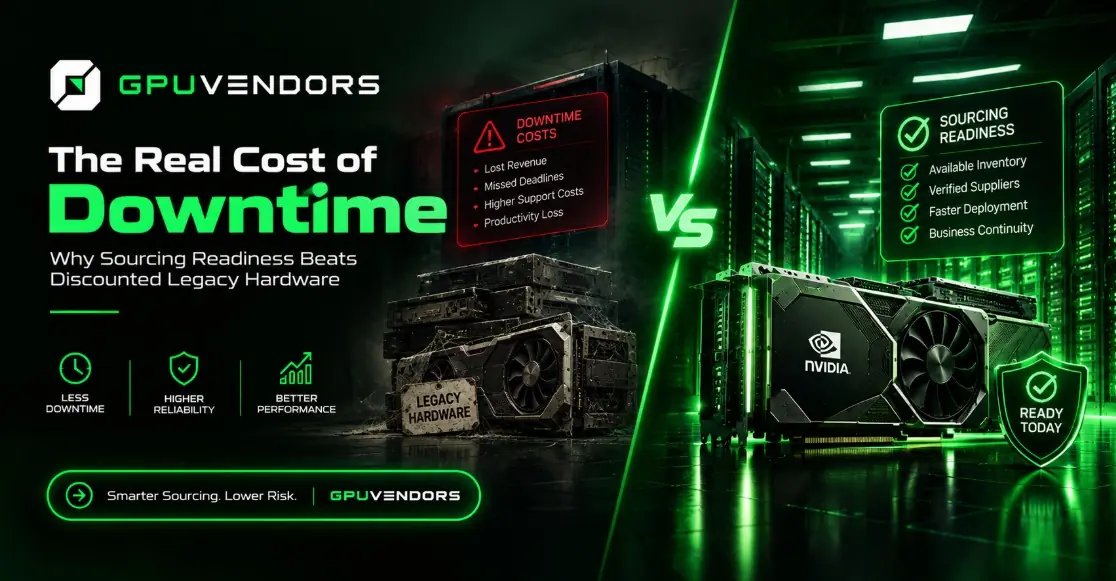
In enterprise infrastructure management, financial decision makers must settle for a "good enough" compromise: purchasing cheaper legacy hardware today versus waiting for next-generation accelerators. While old-generation server nodes and legacy graphic processors appear to reduce upfront costs, this accounting illusion collapses against operational momentum. Slow training speeds, reduced tokens per second, and unscalable inference pipelines generate losses that far exceed hardware savings. Legacy silicon cannot deliver the high memory bandwidth, high-speed interconnects, or dense tensor throughput required for modern AI workloads. Real cost-effectiveness depends on time-to-market and operational continuity rather than invoice line items. For organizations navigating these risks, finding reliable current-generation inventory requires sourcing through the best gpu marketplace.
The Misleading Economics of Legacy Silicon
Purchasing discounted legacy server equipment triggers hidden technical debt. Newer accelerator architectures support mixed-precision scaling and distributed communication primitives that legacy silicon lacks, forcing engineering teams to spend weeks refactoring codebases, managing memory fragmentation, and writing custom kernels. Furthermore, legacy hardware exhibits higher mean-time-between-failure rates, causing unpredictable node crashes during multi-day training jobs. Cluster failures consume hours with Checkpoint recovery, reducing productive compute hours and turning budget hardware into an administrative burden. Procurement officers focused solely on lowest upfront cost ignore engineering opportunity cost, where high-value technical staff waste cycle time managing legacy nodes instead of driving product innovation.
Using ROI Modeling to Calculate Total Financial Impact
Replacing legacy restrictions requires rigorous cost quantification. Back-of-the-envelope calculations severely underestimate how performance bottlenecks drag down corporate revenue streams. Calculating total cost of ownership requires evaluating power per watt of effective compute, rack density utilization, and project extension penalties. Financial leads using tools like calculate your GPU investment return can simulate multi-quarter output deltas between legacy node deployments and current-generation accelerator clusters. The incremental cost of modern hardware is rapidly recovered through shortened training cycles, higher inference concurrency, and lower facility cooling overhead per unit of real output.
Architectural Precision: Designing Current-Generation Nodes Without Delay
Avoiding legacy compromises requires matching computational requirements to proper server node configurations rather than buying clearance inventory. Modern deep learning architectures heavily stress PCIe lanes, InfiniBand or high-throughput RoCE network fabrics, and high-bandwidth memory subsystems. Using legacy interconnects creates severe communication bottlenecks that starve expensive accelerators of data. Reviewing technical blueprints via How to Use Our GPU Configurator: Build Your Perfect Server in Minutes eliminates guesswork, ensuring 100% utilization from every accelerator upon deployment.
Procurement Readiness as a Competitive Defense Mechanism
Resilient enterprises view hardware sourcing readiness as a strategic moat rather than an administrative afterthought. Supply chain volatility prevents relying on discount batches or single-factory allocations. Agile multi-source pipelines, predetermined independent vendor contracts, and timely inventory tracking make demand surges manageable without sacrificing performance. Blending long-term planning with proven spot-market scaling prevents project delays. When technical teams know compliant, up-to-date enterprise accelerators can be accessed on demand, product roadmaps execute without fear of global supply friction.
Conclusion: Prioritizing Velocity and Continuity Over False Economy
The pursuit of discounted legacy hardware represents a classic case of tripping over dollars to pick up pennies. While upfront hardware invoices look leaner, the downstream penalties of delayed deployment, refactoring overhead, and sub-optimal inference throughput destroy long-term enterprise value. By rejecting obsolete compromises, conducting disciplined financial modeling, leveraging precision configuration tools, and securing reliable supply channels, technology leaders transform infrastructure acquisition from a risk factor into a growth engine. Sourcing readiness ensures that engineering velocity matches market ambition, securing durable leadership in high-performance computing and enterprise artificial intelligence adoption.