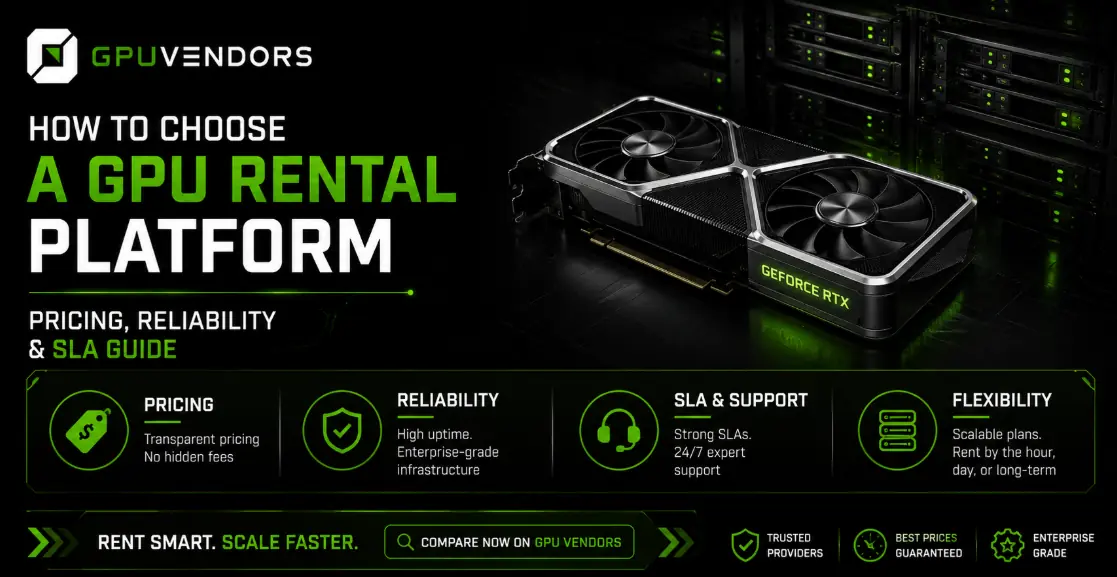
Deploying modern artificial intelligence models, training large language networks, and managing high-performance rendering pipelines require immense computational power. Because purchasing enterprise hardware outright involves substantial capital expenditure and rapid technological turnover, many organizations and developers choose to rent computing power. Finding a dependable partner through a trusted best gpu marketplace ensures that your projects run smoothly without unexpected infrastructure bottlenecks. However, with numerous cloud providers and rental brokers populating the market, selecting the right platform requires careful evaluation.
Evaluating a rental provider involves more than simply scanning hourly rental rates. Reliability, robust service level agreements, network interconnect speeds, and hardware availability dictate whether your training jobs finish on time or suffer frustrating interruptions. Making an informed decision requires looking closely at pricing structures, uptime guarantees, and underlying cloud architectures to align your technical requirements with your financial budget.
Assessing Pricing Models and Cost Transparency
Pricing is often the first metric organizations review, but understanding how different cloud platforms bill for resources is crucial. Cloud providers generally utilize spot instances, on-demand pricing, or reserved cluster tiers, each carrying distinct financial advantages and risks.
Spot instances offer drastically reduced rates by utilizing spare capacity across data centers, but they come with a major catch. If the provider needs those resources back for higher-priority customers, your instance can be preemptively terminated with minimal warning. For fault-tolerant workloads or batch processing, spot pricing provides incredible value. However, for long-running AI training epochs that require checkpoint persistence, sudden interruptions can corrupt progress and waste valuable hours.
On-demand pricing guarantees immediate availability and stability, allowing developers to spin up nodes instantly and run jobs to completion without fear of preemption. While more expensive than spot instances, on-demand options deliver the predictability needed for tight project deadlines. When scaling up complex environments, exploring flexible GPU cloud rental options helps teams balance instant availability with predictable budgeting.
Understanding Total Cost of Ownership and Long-Term Value
Before committing to a long-term rental contract or shifting workflows entirely to the cloud, financial planners must weigh ongoing operational costs against traditional ownership models. Renting removes maintenance burdens, hardware depreciation worries, and cooling logistics, but long-term continuous rentals can eventually surpass the cost of buying physical hardware.
To determine the most financially sound path for your specific project timeline, examine the comprehensive financial breakdowns and capital comparisons detailed in this guide on GPU Rental vs. Purchase: TCO Analysis for AI Workloads. Analyzing total cost of ownership ensures that short-term rental convenience does not inadvertently compromise long-term enterprise profitability.
Evaluating Hardware Reliability and Infrastructure Performance
Raw financial savings mean very little if the underlying hardware fails midway through a critical training cycle. When evaluating a rental platform, you must investigate the physical infrastructure powering the cloud nodes.
Check whether the provider supplies current-generation enterprise accelerators, such as NVIDIA H100, RTX 4080, or RTX 5080 series cards, equipped with high-bandwidth memory and robust thermal solutions. Older or poorly maintained hardware degrades over time, leading to thermal throttling and unexpected driver crashes that halt computation. Furthermore, look into the network interconnect fabric used by the provider. High-speed InfiniBand or low-latency NVLink connections are essential for multi-node training clusters. If individual nodes communicate sluggishly, data bottlenecks will leave expensive compute cores sitting idle.
Reviewing Service Level Agreements and Uptime Guarantees
A service level agreement represents the formal commitment between your organization and the cloud provider regarding system uptime, network availability, and support response times. When evaluating providers, read the fine print of their SLA policies carefully.
A reliable enterprise-grade platform should offer guaranteed uptime percentages, typically aiming for ninety-nine point nine percent availability. Furthermore, investigate their technical support structure. If a server node experiences hardware failure or network packet loss at two in the morning, having access to responsive, knowledgeable support engineers ensures rapid troubleshooting and minimal workflow disruption. Choosing a transparent platform safeguards your computational investments and keeps your AI initiatives moving forward efficiently.