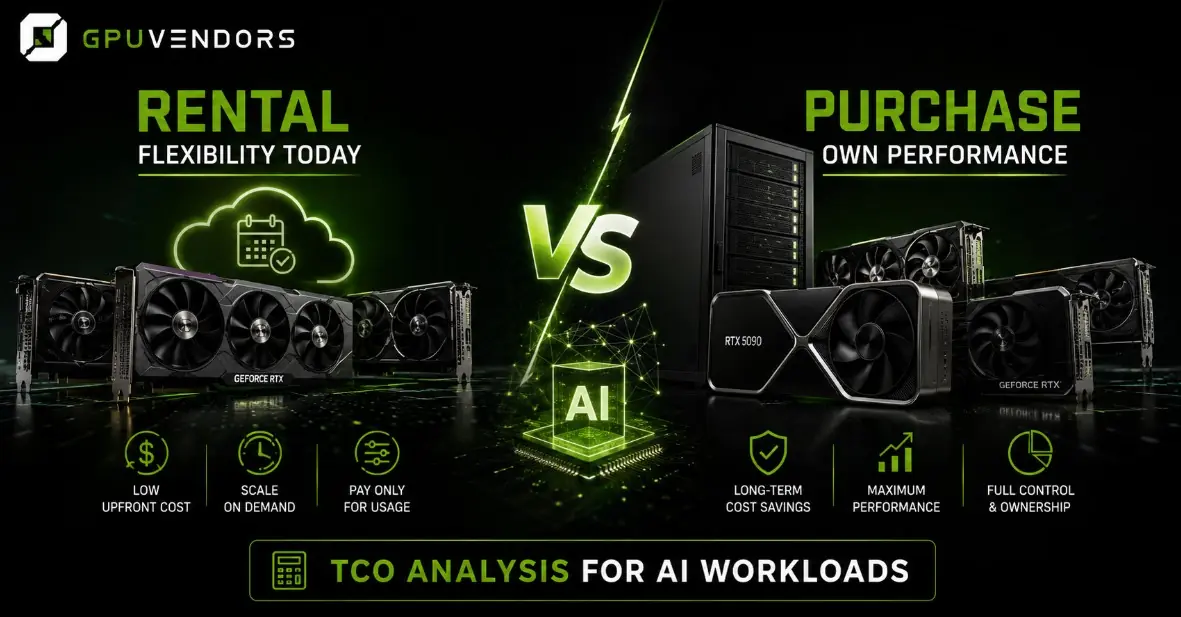
Deploying artificial intelligence infrastructure requires navigating a complex financial landscape. Whether scaling up a fine-tuning pipeline or launching a high-throughput production environment, engineering leaders constantly face a fundamental choice: should you invest massive capital in owning physical silicon, or lean into the flexibility of cloud-based rentals? Evaluating Total Cost of Ownership (TCO) goes far beyond initial sticker prices. It requires an in-depth look at electricity, maintenance, scaling frequency, and hardware depreciation over time.
Capital Expenditure (CapEx) vs. Operational Expenditure (OpEx)
The core financial difference between buying and renting rests on how money flows out of your organization.
The Purchase Model (CapEx): Buying hardware means a heavy upfront investment. However, once the servers are racked, your ongoing costs are limited to datacenter space, power, cooling, and routine maintenance. Over a multi-year lifecycle, owning silicon can become cost-effective for teams running continuous 24/7 workloads.
The Rental Model (OpEx): Renting shifts your expenses into a predictable monthly operational cost. This model eliminates massive upfront barriers to entry, allowing startups and research teams to spin up elite clusters instantly without tying up critical liquidity.
Factors Influencing AI Infrastructure Costs
When calculating your long-term budget, several hidden operational variables dictate whether renting or buying makes more sense for your specific project.
1. Workload Duration and Utilization Rates
If your training pipelines run in intense, sporadic bursts—such as pre-training a foundation model once every six months—renting prevents expensive hardware from sitting idle and depreciating in a rack. Conversely, if your infrastructure handles continuous inference tasks around the clock, long-term rentals can accumulate massive cumulative expenses that far exceed the price of owning the hardware outright.
2. Rapid Hardware Evolution
The hardware landscape moves at a blistering pace. Choosing the
3. Ancillary Costs: Power, Cooling, and Maintenance
Owning physical servers introduces overhead that cloud providers handle behind the scenes. High-density enterprise accelerators draw substantial power, driving up utility bills and requiring advanced thermal management within your facility. Furthermore, hardware failures require active IT labor for component replacement and RMA management.
Projecting Your Budget Accurately
Because every organization's compute requirements are unique—ranging from small-scale LoRA fine-tuning to massive enterprise deployments—estimating exact expenditure requires granular data inputs. To simplify this decision-making process, engineering teams can use the interactive
Making the Final Decision for Your Team
Ultimately, there is no universal winner between renting and buying; it depends entirely on your workload cadence and financial strategy. Organizations seeking reliable, long-term hardware ownership often source enterprise components directly through a trusted