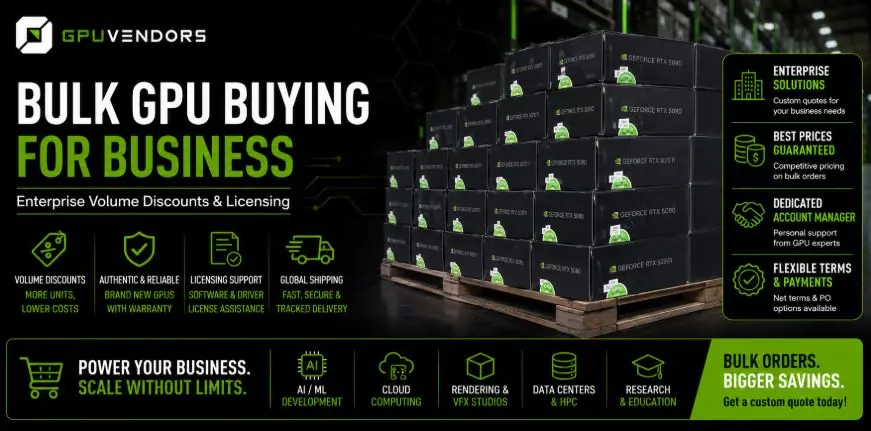
Building large-scale AI infrastructure isn't like buying a single GPU for gaming. Enterprise GPU deployments require careful alignment of compute density, thermal efficiency, software licensing, and capital expenditure management. Technology leaders need to navigate multi-tiered vendor relationships, complex bulk contracts, and licensing models that dramatically impact total cost of ownership (TCO).
The difference between a well-negotiated procurement strategy and overpaying can reach hundreds of thousands of dollars. This guide walks through the key factors enterprise IT teams need to understand to deploy high-density GPU clusters cost-effectively.
1. Understanding Enterprise Volume Discounts and Tiered Pricing
Direct procurement from hardware vendors involves tiered pricing structures based on order volume, commitment duration, and partnership levels. These discounts can be substantial—but only if you know how to negotiate them.
Volume Tiers and Rebate Structures
Most manufacturers offer volume pricing in distinct tiers:
Entry-Level Volume (10-50 Units) Starting at 10 units, vendors typically offer 5-15% discounts off retail pricing. These smaller orders are often handled through authorized resellers and include standard manufacturer support.
Standard Volume (50-100 Units) Orders at this tier unlock 15-25% discounts. Procurement teams also gain access to dedicated account managers and priority fulfillment during supply constraints. This is the sweet spot for mid-market enterprises.
High-Volume Agreements (100+ Units) Orders exceeding 100 GPU units or multi-node server deployments command 25-40% discounts. At this scale, manufacturers also offer back-end rebates, performance incentives, and volume commitments that guarantee hardware allocation even during shortages.
Multi-Year Commitments Long-term procurement agreements (2-3 year contracts) unlock additional discounts—often 10-20% on top of volume pricing. These contracts also secure hardware priority queues, avoiding expensive project delays during supply crunches.
Refurbished and Certified Pre-Owned Channels
For development clusters, testing environments, and non-critical inference pipelines, certified pre-owned (CPO) and refurbished GPUs offer significant savings (30-50% below retail) while maintaining manufacturer warranties.
Key advantage: These are ideal for initial proof-of-concepts and smaller workloads, freeing budget for production-grade hardware where it matters most.
2. The Hidden Costs: Enterprise Software Licensing and Ecosystem Management
GPU hardware cost is only part of the equation. Enterprise deployments require software licensing, driver infrastructure, and support contracts that often rival hardware expenses.
Enterprise Virtualization Licensing
Virtual GPU (vGPU) licensing allows multiple applications to share physical GPU hardware. Licensing models include:
- Per-GPU licensing: Fixed annual cost per physical GPU in the cluster
- Per-socket licensing: Licensed based on CPU sockets in your servers
- Per-virtual-GPU licensing: Costs scale with the number of virtual instances (NVIDIA vGPU, VMware vSphere with GPU acceleration)
For large clusters, per-GPU licensing is typically most cost-effective. However, organizations with significant virtualization requirements benefit from per-virtual-GPU models that scale with actual usage.
AI Stack Support Contracts
Professional machine learning workflows depend on enterprise-grade software stacks and support:
NVIDIA AI Enterprise Includes optimized drivers, container support, and priority developer access. Recommended for production AI workloads, especially those using CUDA-dependent frameworks.
AMD ROCm PRO Enterprise-grade support for AMD GPUs with optimized machine learning libraries. Lower cost than NVIDIA equivalents, but smaller ecosystem for specialized workloads.
Open-Source Frameworks with Support Organizations already using TensorFlow, PyTorch, or other open-source stacks can minimize licensing overhead while maintaining compatibility across nodes.
Critical consideration: Factor support contract costs into your TCO. A $100K GPU cluster without proper support can become a $500K+ disaster during production outages.
Calculate Software Overhead Realistically
Before procurement, audit your software stack:
- What frameworks are your applications built on?
- Do you need vendor-provided drivers or can you use open-source options?
- What's the cost of enterprise support contracts vs. internal development resources?
This analysis often reveals that software costs equal or exceed hardware costs in large deployments.
3. High-Density Hardware Architecture and Interconnect Scaling
When deploying hundreds of GPUs, the physical and electrical architecture becomes critical. How GPUs connect to each other and to power infrastructure determines both performance and total cost.
GPU Form Factors: PCIe vs. OAM/SXM
Standard PCIe GPUs
- Flexible: work in most server chassis
- Accessible: easier to troubleshoot and swap components
- Trade-off: Lower density (typically 1-4 GPUs per server)
- Best for: Mixed-workload clusters, easy maintenance environments
OAM (Open Accelerator Module) & SXM (Server Expansion Module)
- High density: 8+ GPUs per 2U server
- Native high-speed interconnects (direct GPU-to-GPU communication)
- Optimized power delivery: specialized backplanes handle extreme power draw
- Trade-off: Vendor lock-in (typically NVIDIA H100 SXM, AMD MI300 OAM)
- Best for: Training clusters, inference at massive scale
For large AI clusters, OAM/SXM form factors provide superior performance and efficiency. However, they require more specialized infrastructure and vendor commitment.
GPU Fabric and High-Speed Interconnects
Modern AI training relies on ultra-low-latency communication between GPUs:
NVIDIA NVLink Direct GPU-to-GPU communication at 900 GB/s (H100/L40S). Essential for large language model training.
NVIDIA Quantum-2 InfiniBand Fabric Cluster-level networking optimized for GPU-to-GPU collective operations. Scales to thousands of GPUs without bandwidth bottlenecks.
AMD Infinity Fabric Similar to NVIDIA's approach, though less mature in enterprise deployments.
Cost impact: High-speed fabric infrastructure can add $10K-$50K+ per rack depending on scale. Budget this explicitly in your cluster design.
Also read: Enterprise Sourcing: AMD Instinct vs NVIDIA GPU Fabrics
Power and Thermal Management
High-density GPU clusters demand serious infrastructure planning:
Power Density Considerations:
- A single server with 8x H100 SXM GPUs draws 30-50kW
- A full 42U rack can exceed 500kW
- Data centers often lack this capacity; retrofitting can cost millions
Cooling Strategy:
- Air cooling: Standard, but limited to ~10-15kW per rack
- Liquid cooling: Necessary for 30kW+ densities, reduces operating temperatures by 10-20°C
- Direct-to-chip liquid cooling: Most efficient, but requires specialized equipment and expertise
Financial impact: Underestimating power/cooling needs is one of the most expensive procurement mistakes. Budget 15-20% of hardware cost for supporting infrastructure.
4. Vendor Negotiation Strategies for Enterprise Procurement
Technology leaders can use these proven strategies to maximize value from GPU infrastructure investments:
Strategy 1: Request Multi-Vendor Quotes
Get identical hardware configurations priced by multiple vendors:
- Tier-1 OEMs (Dell Technologies, Supermicro, ASUS, Gigabyte)
- System integrators
- Direct manufacturers
This creates competitive pressure and reveals where discounts can be negotiated.
Strategy 2: Unbundle Hardware and Software
Price hardware separately from enterprise software packages. Many vendors bundle expensive software licenses that you may not need.
Example breakdown:
- GPU compute cluster: $500K
- Enterprise software licensing: $100K (separately priced)
- 3-year support contract: $75K (separately priced)
- Total: $675K (now you can negotiate each component independently)
Without unbundling, you might pay $750K for bundled costs you can't negotiate.
Strategy 3: Leverage Marketplace Pricing for Transparency
Before negotiating with vendors, check current marketplace pricing to establish a realistic baseline. A best GPU marketplace allows you to compare:
- Current street prices for GPUs
- Actual inventory availability
- Competitive pricing across vendors
This data gives you negotiating leverage. When a vendor quotes you $500K for 100x H100 GPUs, you can reference live marketplace pricing to identify overcharges.
Check the best GPU marketplace for current pricing data before final negotiations. This ensures your enterprise procurement aligns with realistic market rates rather than inflated enterprise quotes.
Strategy 4: Secure Hardware Priority Guarantees
Negotiate allocation guarantees into your contract. During supply constraints (common with leading-edge GPUs), guaranteed allocation can save months of delays and prevent project costs from doubling.
Example clause: "Supplier guarantees 50% of available H100 inventory for this customer's use at agreed pricing for 24 months."
Strategy 5: Structure Multi-Year Commitments for Maximum Savings
Three-year contracts often unlock 10-20% additional discounts on top of volume pricing. However, negotiate escape clauses for technology obsolescence—AI hardware evolves rapidly.
5. Calculating Total Cost of Ownership (TCO) for GPU Clusters
Enterprise procurement decisions should be based on TCO, not just hardware cost. Use this framework:
Direct Costs:
- GPU hardware (negotiated bulk price)
- Server chassis and interconnect infrastructure
- Networking equipment (InfiniBand, Ethernet)
- Power and cooling infrastructure
Software and Licensing:
- Enterprise driver licenses
- AI stack support contracts
- Virtualization software
- Operating system licenses
Operational Costs (3-Year Horizon):
- Maintenance and support contracts
- Power consumption ($10-20K per 100 GPUs annually)
- Cooling and facility costs
- Staff training and ongoing support
Calculate Example:
- Hardware: $500K
- Software/licensing: $100K
- 3-year operational costs: $150K
- 3-Year TCO: $750K
This $750K baseline is what you actually negotiate against, not the $500K hardware quote alone.
6. Procurement Best Practices: Checklist for IT Teams
Before finalizing any enterprise GPU procurement:
Hardware Validation:
- Benchmark specifications match your actual workload requirements
- Verify performance against independent benchmarks (not vendor marketing claims)
- Confirm thermal and power specifications match your data center infrastructure
Financial Due Diligence:
- Compare marketplace pricing to vendor quotes
- Unbundle all software and licensing costs separately
- Get multi-vendor quotes for identical configurations
- Negotiate volume discounts explicitly
Infrastructure Assessment:
- Audit power delivery capacity (current + future expansion)
- Assess cooling infrastructure requirements
- Plan high-speed interconnect deployment
- Budget 15-20% above hardware cost for supporting infrastructure
Vendor Lock-In Mitigation:
- Prefer open standards where possible (PCIe over proprietary form factors)
- Negotiate software portability clauses
- Avoid excessive virtualization licensing that ties you to one vendor
Contract Terms:
- Secure hardware allocation guarantees
- Include escape clauses for technology obsolescence
- Negotiate maintenance and support terms explicitly
- Clarify warranty coverage and repair timelines
Final Thoughts: Strategic GPU Procurement Wins
Enterprise GPU procurement requires balancing hardware performance, software ecosystem, infrastructure costs, and vendor relationships. Organizations that approach this strategically—not reactively—save 20-40% on total cost of ownership.
The key differentiator is transparency. Cross-reference vendor quotes against marketplace pricing, unbundle software from hardware, and negotiate based on TCO rather than unit price. When your procurement team understands volume tiers, software licensing implications, and infrastructure requirements, even commodity GPU pricing becomes negotiable.
Start with a detailed RFQ (Request for Quote) that specifies workload requirements, volume tiers, and competitive bidding. Then use marketplace data as your verification point to ensure enterprise pricing doesn't inflate above realistic market rates.